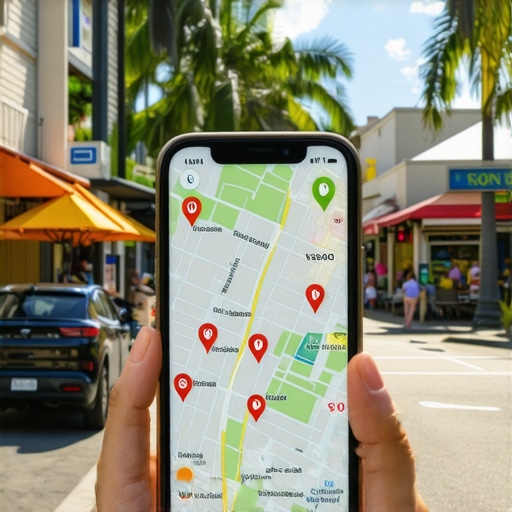
The Invisible Code Helping Hawaii Shops Pop Up in Neighborhood Mobile Searches
The Invisible Code Helping Hawaii Shops Pop Up in Neighborhood Mobile Searches
If you are walking through Kaka’ako looking for a quick espresso, or navigating the busy streets of downtown Honolulu searching for a notary, you likely don’t think about the complex mathematics happening behind your smartphone screen. You simply type a query, and Google presents a Map Pack – the “Holy Grail” of local commerce. But for Hawaii business owners, appearing in that top three isn’t a matter of luck or even just having a great product. It is the result of what I call the “Invisible Code.”
In the landscape of 2026, where AI-driven search and hyper-local intent dominate the digital marketplace, the competition for visibility on the islands has never been more technical. For many local entrepreneurs, google business profile seo is the difference between a ringing phone and a silent storefront. While mainland brands often try to brute-force their way into our markets with massive budgets, they frequently overlook the nuanced, island-specific algorithmic signals that Google prioritizes for Hawaii users. This is precisely Why mainland marketing tactics often fail for Honolulu service businesses; they lack the localized “Invisible Code” required to resonate with both the algorithm and the unique geography of Oahu, Maui, Kauai, and the Big Island.
As we move deeper into an era where 80% of local searches are performed on-the-go via mobile devices, understanding these hidden signals is no longer optional. It is the technical infrastructure upon which your entire digital presence is built. In this guide, we will peel back the layers of the Google Map Pack to reveal how you can optimize your business to dominate the local search landscape in 2026.
The Trinity of Local Ranking: Relevance, Distance, and Prominence
Google’s official documentation is clear: local results are primarily based on relevance, distance, and prominence. However, in the context of Hawaii, these three pillars take on a much more complex character. To rank higher on google maps, a business must master the interplay between these factors while accounting for our unique physical barriers.
The “Pali Highway” Effect on Proximity
In most mainland cities, “Distance” is a straightforward calculation of radius. If you are two miles away, you are closer than someone five miles away. In Hawaii, the algorithm has become increasingly sophisticated at understanding geographic barriers. We call this the “Pali Highway” effect. Research into Hawaii small business search trends shows that signal strength often drops significantly when a user crosses the H-1 or the Pali Highway. Google’s AI understands that a resident in Kailua is unlikely to drive to a “near me” service in Kalihi for a routine task, even if the straight-line distance is short. To compensate for these geographic hurdles, businesses need stronger local citations and neighborhood-specific content to maintain visibility across the ridge.
Relevance in a Multilingual Market
Relevance is how well a local business profile matches what someone is searching for. In 2026, relevance is no longer just about keywords; it’s about semantic intent. Google’s algorithm now parses “Invisible Code” within your profile to see if you offer the specific experience a user wants. For a Honolulu business, this means ensuring your profile reflects the local vernacular and specific services that islanders look for. If your profile isn’t meticulously tuned, you’ll find that Why Being the Closest Shop Still Won’t Get You the Top Map Spot in Hawaii – relevance often trumps proximity if the algorithm deems a competitor a better “match” for the user’s specific intent.
Prominence and Digital Authority
Prominence refers to how well-known a business is. This is calculated through a combination of your web position, review count, and local mentions. It is a digital reflection of your “mana” in the marketplace. For a deeper dive into how these factors coalesce, check out The 2026 Guide to Hawaii Local Map Pack Dominance. Building prominence requires a consistent effort to acquire high-quality local backlinks and maintain a pristine digital reputation that tells Google you are a trusted pillar of the community.
Cracking the Code: The Power of Primary Categories
If there is one “master key” in the Invisible Code, it is your Primary Category selection within your Google Business Profile (GBP). According to 2025 and 2026 industry research, the Primary Category remains the single most influential ranking factor for the Map Pack. Yet, it is also where most Hawaii businesses make their most critical errors.
Proper google business profile optimization starts with selecting the most specific category that describes your core business. Many owners fall into the trap of “category dilution” – selecting too many secondary categories in hopes of casting a wide net. In reality, this often confuses the algorithm and weakens your “Invisible Code” for your most profitable services. If you are a “Plumber,” don’t lead with “Handyman” just because you occasionally fix a fence. You want the algorithm to have 100% confidence in your primary identity.
- Audit Your Competitors: Look at the top three businesses in the Map Pack for your main keyword. What is their primary category? Often, you’ll find a niche category you hadn’t considered.
- Seasonal Adjustments: While you shouldn’t change your category weekly, Hawaii businesses often benefit from subtle shifts during peak tourism seasons or local event cycles.
- Avoid Overlapping: Ensure your secondary categories don’t contradict your primary one.
Identifying and fixing these issues is vital. Many businesses are losing thousands in potential revenue due to 5 Google Business Profile errors that drive island shoppers to your rivals. By sharpening your category focus, you send a clear, high-intensity signal to Google’s ranking engine.
Neighborhood Signals and Hyper-Local SEO
In 2026, broad “Honolulu” signals are losing their potency. The algorithm has shifted toward “hyper-local” neighborhood signals. To Google, a business in Waikiki is fundamentally different from a business in Kapolei, even if they share a zip code or city designation. To win the Map Pack, you must signal to the algorithm that you are the authority in specific micro-neighborhoods.
This is where local map pack seo becomes a game of “digital turf.” You can build these signals by:
- Creating location-specific landing pages on your website that mention local landmarks (e.g., “located just steps from Ala Moana Center” or “serving the families of Hawaii Kai”).
- Embedding Google Maps on your site that are centered on your specific neighborhood.
- Acquiring mentions from neighborhood-specific blogs or community associations.
We have seen incredible results with this strategy. We detailed the process in our case study on How We Beat Mainland Chains in the Map Pack Using Hyper-Local Neighborhood Signals. By focusing on the “Invisible Code” of neighborhood landmarks and local geography, smaller Hawaii shops can actually outrank national brands that have more “authority” but less “local relevance.”
Furthermore, Mastering Geo-Grid Tracking for Oahu Service Areas allows you to see exactly where your visibility drops off. You might rank #1 in Manoa but drop to #10 in Makiki. This data allows you to target your SEO efforts with surgical precision, reinforcing your neighborhood signals where they are weakest. If you’ve ever wondered Why Your Honolulu Business Isn’t Showing Up in Waikiki Searches, the answer usually lies in a lack of these micro-geographic signals.
The Review Engine: Trust as a Technical Signal
We all know reviews are important for social proof – people want to see that others had a good experience. But in the world of the Invisible Code, reviews are technical data points. Google’s AI doesn’t just count the stars; it reads the text. When a customer leaves a review saying, “The best plumber in Honolulu fixed my leak in Moiliili,” they are providing Google with a high-value relevance signal.
To leverage this, you must encourage customers to be descriptive. Keywords within reviews act as organic boosters for your ranking. Using local seo tools to monitor and manage these reviews is essential for maintaining a high-velocity feedback loop. The more frequently you receive reviews containing your target keywords and neighborhood names, the higher your prominence score climbs.
However, managing this at scale can be daunting. Many owners struggle to find the balance between being proactive and being annoying. Learning How to automate your Google reviews without sounding like a bot is a crucial skill for the modern Hawaii business owner. You need a system that captures the “Aloha spirit” of your business while systematically building the technical data Google needs to justify ranking you at the top.
Technical Review Optimization Tips:
- Respond to Every Review: Responses are indexed. Use them to naturally include your service areas and keywords.
- Photos are Metadata: Encourage customers to upload photos. Google uses image recognition to verify that your business actually does what you say it does.
- Velocity Matters: A steady stream of two reviews a week is better than twenty reviews in one day followed by months of silence.
2026 AI Search & The Future of Hawaii Maps
As we look toward the future, the “Invisible Code” is evolving. Google’s Search Generative Experience (SGE) and other AI-driven search models are changing how Hawaii locals find services. Instead of typing “Electrician Honolulu,” users are now asking their AI assistants, “Who is the best electrician near me that can come to Waialua today and specializes in solar battery backup?”
This shift toward conversational, long-tail queries requires a more robust approach to google maps seo. Your profile must be “AI-ready.” This means filling out every single attribute in your GBP, from “wheelchair accessible” to “locally owned and operated.” These attributes are the building blocks that AI uses to construct answers for complex user queries.
According to the “Hawaii Small Business Search Trends, 2026 Edition,” businesses that have fully optimized their attributes see a 40% higher engagement rate in AI-generated search results. To stay ahead of this curve, you should implement the 3 Hawaii Google Maps Fixes to Win the 2026 AI Search Race. These include optimizing your “From the Business” description with natural language and ensuring your Q&A section is populated with the questions your customers actually ask.
The future of search is personalized. Google knows the user’s history, their current location, and their preferences. The Invisible Code you embed in your profile today is what will allow Google’s AI to confidently recommend your business to the right person at the right time. Using advanced google maps seo tools will help you stay updated on how these AI models are interpreting your data in real-time.
Conclusion: Mastering the Island’s Digital Grid
The “Invisible Code” may seem daunting, but it is ultimately a set of logical, manageable signals. For Hawaii businesses, the key is to stop thinking like a mainland marketer and start thinking like a local guide. By focusing on geographic relevance, primary category integrity, hyper-local neighborhood signals, and the technical power of reviews, you can build a Map Pack presence that is virtually unshakeable.
In 2026, the businesses that thrive will be those that treat their Google Business Profile not as a static listing, but as a dynamic, data-rich engine. Whether you are a surf school in Haleiwa or a law firm in downtown Honolulu, the principles remain the same: give the algorithm the specific, localized data it craves, and it will reward you with the visibility you deserve.
If you’re ready to take control of your local presence, start by implementing these 5 Honolulu Local SEO Steps to Outperform 2026 Search Rivals. If the technical side feels overwhelming, consider utilizing professional local seo software to track your progress and identify gaps in your “Invisible Code.” The digital landscape of Hawaii is competitive, but for those who know how to read the code, the opportunities are limitless. Let’s make sure when the next person in your neighborhood searches for what you offer, your business is the first one they see.